
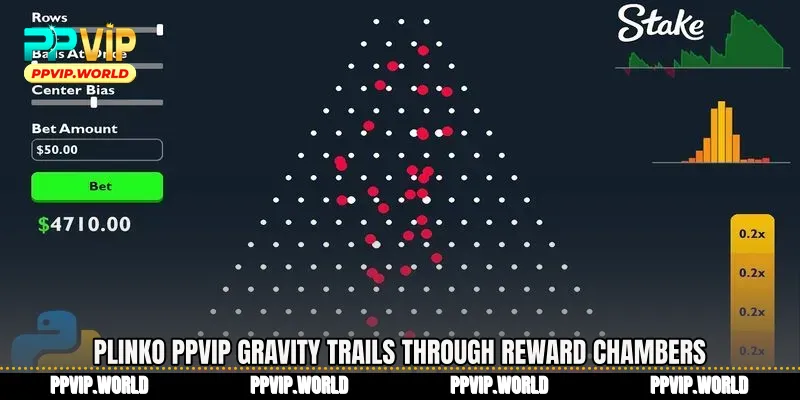
Plinko stands among the most distinctive probability-based titles available through PPVIP. Instead of relying on cards, reels, or traditional table mechanics, the experience focuses on a falling ball moving through a carefully structured peg board. Every collision changes direction, creating thousands of possible paths before the ball reaches a reward slot. What allows a simple drop to generate outcomes ranging from a fraction of a stake to hundreds of times its value? The answer lies within board geometry, multiplier placement, risk configuration, probability distribution, plus reward calculations.
Foundations Of The Falling Ball System

Unlike many digital casino titles, Plinko does not depend upon symbol combinations or hand rankings. The entire structure revolves around a ball descending through rows of pegs. Every impact redirects movement toward the left or right side. After passing through all rows, the ball settles inside a multiplier slot positioned along the bottom edge. Each round begins with stake selection. The chosen amount in BDT becomes the basis for reward calculations. Once activated, the ball enters the board from the upper section. From that point forward, movement follows predetermined probability rules.
The board appears simple, yet path complexity grows rapidly as row count increases.
| Board Element | Typical Value |
| Minimum Stake | 10 BDT |
| Maximum Stake | 50,000 BDT |
| Row Range | 8–16 |
| Risk Levels | 3 |
| Multiplier Range | 0.2x–1000x |
| Reward Slots | 9–17 |
Central slots receive more landings because numerous pathways converge toward the middle area. Edge positions contain larger rewards because fewer routes reach them.
See more: Bonus Dice
Plinko Risk Profiles And Probability Mapping

Risk selection represents the most influential decision within Plinko. Before a ball begins its descent, a participant chooses a volatility setting. This selection changes multiplier allocation across the board without altering the fundamental movement system. Higher volatility introduces larger rewards near extreme edges. Lower volatility creates more balanced payout distribution throughout the board.
Low Risk Configuration
Low-risk boards prioritize stability. Smaller multipliers appear frequently, reducing dramatic fluctuations. Because rewards remain clustered around moderate values, sessions often produce smoother outcome patterns.
| Slot Area | Typical Multiplier |
| Center | 0.8x–1.5x |
| Near Center | 1.5x–3x |
| Outer Area | 3x–9x |
Medium Risk Distribution
Medium risk balances consistency with reward potential. Multiplier ranges become wider, creating greater variance. This setting attracts attention because it combines frequent activity with occasional high-value outcomes.
| Slot Area | Typical Multiplier |
| Center | 0.5x–2x |
| Near Center | 2x–8x |
| Outer Area | 8x–50x |
High Risk Architecture
High-risk boards concentrate premium rewards near edge positions. The highest multipliers available within Plinko typically appear under this configuration.
| Slot Area | Typical Multiplier |
| Center | 0.2x–1x |
| Near Center | 2x–20x |
| Outer Area | 20x–1000x |
Why Central Slots Appear More Frequently
Probability naturally favors the center because multiple directional combinations lead toward middle positions. This structure explains why premium multipliers remain difficult to reach despite continuous visibility throughout the board.
| Position | Relative Frequency |
| Center | Very High |
| Near Center | High |
| Mid Section | Moderate |
| Outer Section | Low |
| Extreme Edge | Very Low |
Reward Mechanics Inside Plinko

The reward framework of Plinko depends entirely upon multipliers. Every slot contains a predefined value. Once a ball lands inside a slot, that multiplier applies to the original stake. The simplicity of this formula contributes significantly to transparency.
Multiplier-Based Return Calculation
Reward determination follows a straightforward mathematical process. Every outcome emerges directly from the multiplier associated with the final landing position.
| Stake | Multiplier | Return |
| 100 BDT | 2x | 200 BDT |
| 100 BDT | 10x | 1,000 BDT |
| 100 BDT | 50x | 5,000 BDT |
| 100 BDT | 100x | 10,000 BDT |
| 100 BDT | 500x | 50,000 BDT |
Common Multiplier Placement Structure
Most versions of Plinko organize rewards according to slot location. This arrangement balances frequency against reward size.
| Board Position | Typical Reward |
| Center | 0.5x–2x |
| Near Center | 2x–5x |
| Mid Edge | 5x–20x |
| Outer Edge | 20x–100x |
| Extreme Edge | 100x–1000x |
Premium Reward Events
Premium outcomes occur when the ball reaches rare edge locations. Such events represent the highest-value tier available within the game. These outcomes remain uncommon because very specific path combinations are required.
| Multiplier | Return From 200 BDT |
| 50x | 10,000 BDT |
| 100x | 20,000 BDT |
| 250x | 50,000 BDT |
| 500x | 100,000 BDT |
| 1000x | 200,000 BDT |
Independent Outcome Principles
Every activation functions independently. Previous results create no influence over future trajectories.
Key characteristics include:
- Each ball begins under identical probability conditions
- Earlier multipliers do not affect future multipliers
- Edge results remain rare regardless of recent outcomes
- Probability resets after every completed round
- Long streaks remain mathematically possible
Reward Balance Across Sessions
Within PPVIP, reward structures maintain balance through carefully distributed multiplier placement. Smaller rewards appear more frequently because they occupy positions reached by numerous paths. Premium rewards occupy zones accessible through limited route combinations. This design ensures that Plinko remains driven by probability rather than predictable progression.
See more: Baccarat
Advanced Board Structures And Statistical Behavior

Beyond basic reward calculations, advanced board mechanics reveal why session outcomes often vary significantly.
Board Depth And Path Expansion
Each additional row dramatically increases the number of potential trajectories. Greater depth creates more complex movement behavior before the ball reaches a reward slot.
| Rows | Possible Paths |
| 8 | 256 |
| 10 | 1,024 |
| 12 | 4,096 |
| 14 | 16,384 |
| 16 | 65,536 |
Session Variance Analysis
Variance measures how widely results fluctuate during activity.
| Session Length | Stability Level |
| 20 Drops | Low |
| 50 Drops | Moderate |
| 100 Drops | Noticeable |
| 250 Drops | Significant |
| 500 Drops | Strong Trend Visibility |
Stake Scaling Examples
Identical multipliers produce different reward values when stake amounts change. Multiplier behavior remains constant regardless of stake size.
| Stake | 20x Reward | 100x Reward |
| 20 BDT | 400 BDT | 2,000 BDT |
| 100 BDT | 2,000 BDT | 10,000 BDT |
| 500 BDT | 10,000 BDT | 50,000 BDT |
| 1,000 BDT | 20,000 BDT | 100,000 BDT |
Common Board Configurations
Different versions available through PPVIP may feature varying board layouts. Each structure creates a unique probability landscape.
| Configuration | Rows | Maximum Multiplier |
| Compact | 8 | 100x |
| Standard | 10 | 250x |
| Extended | 14 | 500x |
| Premium | 16 | 1000x |
Statistical Characteristics Of Long Sessions
These characteristics explain why some sessions produce modest returns while others generate substantial outcomes. Several mathematical principles influence extended activity:
- Larger sample sizes reduce short-term anomalies
- Central slots remain dominant across most sessions
- Premium multipliers occur irregularly
- Variance increases alongside risk level
- Row count affects path complexity
- Reward distribution follows probability concentration
Mathematical Design Philosophy
The architecture of Plinko combines simplicity with statistical depth. A participant sees only a falling ball, yet thousands of possible routes exist beneath the surface. Each peg collision contributes to the final destination. Each destination contains a multiplier connected directly to reward value. Through this structure, PPVIP delivers a probability-driven environment where geometry, variance, risk selection, multiplier placement, plus path frequency work together continuously. The result is a system capable of producing both stable outcomes plus extraordinary rewards without sacrificing transparency.
Conclusion
Plinko transforms a simple falling-ball concept into a sophisticated probability experience built around multiplier allocation, risk management, board depth, plus statistical variance. Transparent reward calculations allow outcomes to remain easy to understand while maintaining substantial depth beneath the surface. From low-volatility configurations to premium 1000x multiplier opportunities, every session introduces unique possibilities. Explore the excitement today through PPVIP to experience dynamic reward paths shaped by mathematics, probability, plus carefully balanced game design.


